The "Bonus Army," Consisting of U.s. World War I Veterans and Their Families, Was Defeated by
| Bonus Army | |||
|---|---|---|---|
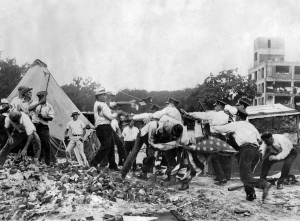 Bonus Army marchers (left) clash with the police. | |||
| Date | July 28, 1932 | ||
| Location | Washington D.C., U.s. | ||
| Caused by | Impoverishment of WWI veterans from the Depression | ||
| Resulted in | Demonstrators dispersed, demands rejected, Herbert Hoover loses 1932 presidential election | ||
| Parties to the civil conflict | |||
| |||
| Lead figures | |||
| |||
| Number | |||
| |||
| Casualties and losses | |||
| |||

The Bonus Army was a group of 43,000 demonstrators – fabricated up of 17,000 veterans of the United States in World State of war I, together with their families and affiliated groups – who gathered in Washington, D.C. in mid-1932 to demand early cash redemption of their service bonus certificates. Organizers called the demonstrators the "Bonus Expeditionary Force" (B.E.F.), to echo the name of Globe State of war I's American Expeditionary Forces, while the media referred to them as the "Bonus Ground forces" or "Bonus Marchers". The demonstrators were led past Walter W. Waters, a former sergeant.
Many of the war veterans had been out of work since the showtime of the Nifty Depression. The World War Adapted Bounty Act of 1924 had awarded them bonuses in the form of certificates they could not redeem until 1945. Each document, issued to a qualified veteran soldier, bore a face value equal to the soldier's promised payment with compound involvement. The principal demand of the Bonus Ground forces was the immediate cash payment of their certificates.
On July 28, 1932, U.S. Attorney General William D. Mitchell ordered the veterans removed from all government property. Washington law met with resistance, shot at the protestors, and two veterans were wounded and later died. President Herbert Hoover then ordered the U.South. Army to clear the marchers' army camp. Regular army Chief of Staff General Douglas MacArthur commanded a contingent of infantry and cavalry, supported past vi tanks. The Bonus Regular army marchers with their wives and children were driven out, and their shelters and property burned.
A second, smaller Bonus March in 1933 at the start of the Roosevelt assistants was defused in May with an offer of jobs with the Noncombatant Conservation Corps at Fort Hunt, Virginia, which most of the group accustomed. Those who chose not to piece of work for the CCC by the May 22 deadline were given transportation domicile.[2] In 1936, Congress overrode President Roosevelt'due south veto and paid the veterans their bonus ix years early.
Origin of military machine bonuses [edit]
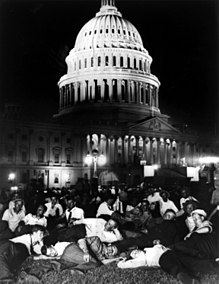
Members of the Bonus Ground forces camped out on the backyard of the U.S. Capitol edifice
The exercise of state of war-time military bonuses began in 1776, every bit payment for the divergence between what a soldier earned and what he could take earned had he non enlisted. The practice derived from English legislation passed in the 1592–93 session of Parliament to provide medical intendance and maintenance for disabled veterans and bonuses for serving soldiers.
In August 1776, Congress adopted the get-go national alimony law providing one-half pay for life for disabled veterans. Considerable force per unit area was applied to expand benefits to friction match the British system for serving soldiers and sailors but had fiddling support from the colonial regime until mass desertions at Valley Forge that threatened the existence of the Continental Army led George Washington to go a strong advocate.
In 1781, near of the Continental Army was demobilized. Two years later, hundreds of Pennsylvania war veterans marched on Philadelphia, then the nation's capital, surrounded the Country House, where the U.South. Congress was in session, and demanded dorsum pay. Congress fled to Princeton, New Jersey, and several weeks later, the U.South. Army expelled the war veterans from Philadelphia.[ citation needed ] Congress progressively passed legislation from 1788 covering pensions and bonuses, eventually extending eligibility to widows in 1836.[3]
Earlier Earth War I, the soldiers' military service bonus (adjusted for rank) was land and coin; a Continental Army individual received 100 acres (twoscore ha) and $80.00 (2017: $i,968.51) at war's finish, while a major general received i,100 acres (450 ha). In 1855, Congress increased the country-grant minimum to 160 acres (65 ha), and reduced the eligibility requirements to fourteen days of military service or i battle; moreover, the bonus as well practical to veterans of any Indian war. The provision of land eventually became a major political issue, particularly in Tennessee where almost 40% of arable land had been given to veterans equally part of their bonus. Past 1860, 73,500,000 acres (29,700,000 ha) had been issued and lack of available arable state led to the program's abandonment and replacement with a cash-but system.[ commendation needed ] Breaking with tradition, the veterans of the Spanish–American State of war did not receive a bonus and after World War I, that became a political thing when they received merely a $60 bonus.[4] The American Legion, created in 1919, led a political movement for an additional bonus.[5]

On May 15, 1924, President Calvin Coolidge vetoed a bill granting bonuses to veterans of World War I, saying: "patriotism... bought and paid for is not patriotism." Congress overrode his veto a few days later,[5] enacting the World War Adjusted Compensation Human activity. Each veteran was to receive a dollar for each day of domestic service, up to a maximum of $500 (equivalent to $7,600 in 2020), and $1.25 for each twenty-four hours of overseas service, up to a maximum of $625 (equivalent to $ix,400 in 2020).[6] Deducted from this was $60, for the $sixty they received upon discharge. Amounts of $fifty or less were immediately paid. All other amounts were issued as Certificates of Service maturing in 20 years.[7]
At that place were iii,662,374 Adjusted Service Certificates issued, with a combined face value of $3.64 billion (equivalent to $55 billion in 2020).[eight] Congress established a trust fund to receive 20 almanac payments of $112 one thousand thousand that, with interest, would finance the 1945 disbursement of the $3.638 billion for the veterans. Meanwhile, veterans could borrow upwardly to 22.5% of the certificate's face value from the fund; only in 1931, because of the Great Low, Congress increased the maximum value of such loans to l% of the certificate'south confront value.[9] Although there was congressional support for the immediate redemption of the military machine service certificates, Hoover and Republican congressmen opposed such action and reasoned that the government would have to increment taxes to cover the costs of the payout then any potential economical recovery would be slowed.[ten]
The Veterans of Foreign Wars continued to press the federal authorities to permit the early redemption of war machine service certificates.[xi]
The first march of the unemployed was Coxey's Army in 1894, when armies of men from various regions streamed to Washington as a "living petition" to need that the federal government create jobs by investing in public infrastructure projects.[12] In January 1932, a march of 25,000 unemployed Pennsylvanians, dubbed "Cox's Army", had marched on Washington, D.C., the largest demonstration to engagement in the nation'due south capital, setting a precedent for future marches by the unemployed.[ commendation needed ]
Camp [edit]

Most of the Bonus Ground forces (Bonus Expeditionary Strength or BEF) camped in a course of "Hooverville" on the Anacostia Flats (now Section C of Anacostia Park), a swampy, muddied area away from the federal core of Washington. Approximately 10,000 veterans, women and children lived in the shelters that they built from materials dragged out of a junk pile nearby, which included old lumber, packing boxes, and scrap tin covered with roofs of thatched straw.[13] Other veterans lived much closer, in partially demolished buildings on Pennsylvania Avenue nigh the Third Street SW.[14] [15] The camps were tightly controlled by the veterans, who laid out streets, built sanitation facilities, and held daily parades. To live in the camps, veterans were required to register and to prove they had been honorably discharged.[ citation needed ] The Superintendent of the D.C. Police, Pelham D. Glassford, worked with camp leaders to supply the camp with nutrient, amongst other things.
On June 15, 1932, the US Firm of Representatives passed the Wright Patman Bonus Bill (by a vote of 211–176) to move forward the appointment for World War I veterans to receive their cash bonus.[xvi] Over half dozen,000 bonus marchers massed at the U.S. Capitol on June 17 as the U.Southward. Senate voted on the Bonus Neb. The bill was defeated past a vote of 62–18.[17]
Police shooting [edit]
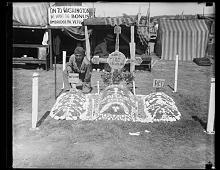
On July 28, nether prodding from the Herbert Hoover, the D.C. Commissioners ordered Pelham D. Glassford to clear their buildings, rather than letting the protesters migrate away every bit he had previously recommended. When the veterans rioted, an officeholder (George Shinault) drew his revolver and shot at the veterans, two of whom, William Hushka and Eric Carlson, died later.[18] [1]
- William Hushka (1895–1932) was an immigrant to the U.s.a. from Lithuania. When the The states entered Globe War I in 1917, he sold his butcher shop in St. Louis, and joined the army. Later the war, he lived in Chicago.[i] He was cached in Arlington National Cemetery a week after being shot and killed by police.[xix] [20]
- Eric Carlson (1894–1932) was a veteran from Oakland, California who fought in the trenches of French republic in Earth State of war I.[1] [21] [22] He was interred in Arlington National Cemetery.[23]
During a previous anarchism, the Commissioners asked the White Firm for federal troops. Hoover passed the request to Secretarial assistant of War Hurley, who told MacArthur to accept activity to disperse the protesters. Towards the belatedly afternoon, cavalry, infantry, tanks and motorcar guns pushed the "Bonusers" out of Washington.[24]
Reports on communist elements [edit]
An Army intelligence report claimed that the BEF intended to occupy the Capitol permanently and instigate fighting, as a indicate for communist uprisings in all major cities. It also conjectured that at least part of the Marine Corps garrison in Washington would side with the revolutionaries, hence Marine units eight blocks from the Capitol were never called upon. The report of July v, 1932 by Conrad H. Lanza in upstate New York was not declassified until 1991.[25]
The Department of Justice released an investigative report on the Bonus Army in September 1932, noting that communists had attempted to involve themselves with the Bonus Army from the commencement, and had been arrested for diverse offenses during protests:
- Equally soon every bit the bonus march was initiated, and equally early every bit May, 1932, the Communist political party undertook an organized campaign to foment the motility, and induced radicals to bring together the marchers to Washington. Equally early as the edition of May 31, 1932, the Daily Worker, a publication which is the fundamental organ of the Communist political party in the U.s.a., urged worker veteran delegations to go to Washington on June 8th.[26]
In 1932, Hoover stated that the bulk of Bonus Army members behaved reasonably and a minority of what he described as communists and career criminals were responsible for almost of the unrest associated with the events: "I wish to land emphatically that the extraordinary proportion of criminal, Communist, and nonveteran elements amongst the marchers as shown by this report, should not be taken to reverberate upon the many thousands of honest, police force-abiding men who came to Washington with full right of presentation of their views to the Congress. This better element and their leaders acted at all times to restrain crime and violence, but after the adjournment of Congress a large portion of them returned to their homes and gradually these better elements lost control."[26] In his 1952 memoir, Hoover stated that at least 900 of the Bonus Army were "ex-convicts and Communists."[27]
In his memoir The Whole of Their Lives (1948) Larry Gitlow of the Communist Party U.s.a. reported that a number of communists had joined the Bonus Army during their trek across the nation, with the goal of recruiting people to the communist cause.[28]
The Encyclopedia Britannica web log noted in 2009 how these would-be communist organizers were largely rejected by the Bonus Army marchers: "[T]here were communists present in the camps, led by John T. Step from Michigan. But if Pace believed that Bonus Army was a ready-made revolutionary cadre, he was mistaken. The marchers routinely expelled avowed communists from the camps. They destroyed communist leaflets and other literature. And amidst their other slogans the veterans adopted a motto directed at the communists, 'Eyes front—non left!'"[29]
Army intervention [edit]
At 1:40 pm MacArthur ordered General Perry Miles to assemble troops on the Ellipse immediately south of the White House. Within the hour the tertiary Cavalry led by Patton, then a Major, crossed the Memorial Bridge, with the 12th Infantry arriving by steamer about an 60 minutes later. At 4 pm Miles told MacArthur that the troops were set, and MacArthur (similar Eisenhower, by now in service uniform), said that Hoover wanted him "on hand" to "take the rap if ..."[ citation needed ]
At four:45 pm. commanded by General Douglas MacArthur, the 12th Infantry Regiment, Fort Howard, Maryland, and the 3rd Cavalry Regiment, supported by six M1917 low-cal tanks commanded past Maj. George Southward. Patton, formed in Pennsylvania Avenue while thousands of civil service employees left work to line the street and scout. The Bonus Marchers, assertive the troops were marching in their honour, cheered the troops until Patton ordered[ commendation needed ] the cavalry to accuse them, which prompted the spectators to yell, "Shame! Shame!"[ citation needed ]

Shacks that members of the Bonus Army erected on the Anacostia Flats burning afterwards attack past the army.
After the cavalry charged, the infantry, with fixed bayonets and tear gas (adamsite, an arsenical vomiting agent) entered the camps, evicting veterans, families, and campsite followers. The veterans fled beyond the Anacostia River to their largest camp, and Hoover ordered the assail stopped. MacArthur chose to ignore the president and ordered a new set on, claiming that the Bonus March was an attempt to overthrow the United states government. 55 veterans were injured and 135 arrested.[1] A veteran's wife miscarried. When 12-calendar week-old Bernard Myers died in the hospital after being caught in the tear gas assault, a authorities investigation reported he died of enteritis, and a hospital spokesman said the tear gas "didn't do it any adept."[30]
During the armed services performance, Major Dwight D. Eisenhower, subsequently the 34th president of the The states, served as 1 of MacArthur's junior aides.[31] Believing it wrong for the Ground forces's highest-ranking officer to atomic number 82 an activity against fellow American war veterans, he strongly advised MacArthur against taking any public role: "I told that impaired son-of-a-bitch not to go downwardly there," he said after. "I told him information technology was no identify for the Chief of Staff."[32] Despite his misgivings, Eisenhower wrote the Army'southward official incident written report that endorsed MacArthur'southward behave.[33]
Although the troops were ready, Hoover twice sent instructions to MacArthur not to cross the Anacostia bridge that night, both of which were received. Shortly after 9 pm, MacArthur ordered Miles to cross the bridge and adios the Bonus Army from its encampment in Anacostia.[34] This refusal to follow orders was claimed by MacArthur'due south assistant chief of staff George Van Horn Moseley. Yet, MacArthur's adjutant Dwight Eisenhower, Banana Secretary of State of war for Air F. Trubee Davison, and Brigadier Full general Perry Miles, who commanded the footing forces, all disputed Moseley'south claim. They said the two orders were never delivered to MacArthur and they blamed Moseley for refusing to deliver the orders to MacArthur for unknown reasons.[35] [36] The shacks in the Anacostia Camp were then attack fire, although who gear up them on fire is somewhat unclear.
Aftermath [edit]
Joe Angelo, a decorated hero from the war who had saved Patton'south life during the Meuse-Argonne offensive on September 26, 1918, approached him the day subsequently to sway him. Patton, however, dismissed him speedily. This episode was said to represent the proverbial essence of the Bonus Army, each homo the face of each side: Angelo the dejected loyal soldier; Patton the unmoved government official unconcerned with past loyalties.[37]
Though the Bonus Ground forces incident did non derail the careers of the military officers involved, it proved politically disastrous for Hoover, and it is considered a contributing gene to his losing the 1932 election in a landslide to Franklin D. Roosevelt.[38]
Police Superintendent Glassford was not pleased with the conclusion to have the Army intervene, believing that the police could have handled the situation. He soon resigned as superintendent.
MGM released the moving-picture show Gabriel Over the White Firm in March 1933, the month Roosevelt was sworn in equally president. Produced by William Randolph Hearst'southward Cosmopolitan Pictures, it depicted a fictitious President Hammond who, in the film's opening scenes, refuses to deploy the war machine against a march of the unemployed and instead creates an "Ground forces of Structure" to work on public works projects until the economy recovers.[39] First Lady Eleanor Roosevelt judged the moving-picture show's treatment of veterans superior to Hoover'due south.[40]
During the presidential campaign of 1932, Roosevelt had opposed the veterans' bonus demands.[41] A second bonus march planned for the following yr in May by the "National Liaison Committee of Washington," disavowed by the previous twelvemonth'south bonus army leadership, demanded that the Federal government provide marchers housing and food during their stay in the capital.[42] Despite his opposition to the marchers' demand for firsthand payment of the bonus, Roosevelt greeted them quite differently than Hoover had washed. The administration fix a special campsite for the marchers at Fort Chase, Virginia, providing forty field kitchens serving three meals a twenty-four hours, jitney transportation to and from the capital, and entertainment in the form of military bands.[43]
Administration officials, led past presidential confidant Louis Howe, tried to negotiate an end to the protest. Roosevelt arranged for his married woman, Eleanor, to visit the site unaccompanied. She lunched with the veterans and listened to them perform songs. She reminisced nearly her memories of seeing troops off to Globe War I and welcoming them dwelling. The most that she could offer was a promise of positions in the newly created Civilian Conservation Corps (CCC).[xl] One veteran commented, "Hoover sent the army, Roosevelt sent his married woman."[44] In a printing briefing following her visit, the Showtime Lady described her reception as courteous and praised the marchers, highlighting how comfortable she felt despite critics of the marchers who described them as communists and criminals.[40]
Roosevelt afterwards[ when? ] issued an executive order allowing the enrollment of 25,000 veterans in the CCC, exempting them from the normal requirement that applicants be single and under the age of 25.[45] Congress, with Democrats holding majorities in both houses, passed the Adjusted Compensation Payment Human action in 1936, authorizing the immediate payment of the $2 billion in Globe War I bonuses, and then overrode Roosevelt's veto of the measure.[46] The House vote was 324 to 61,[47] and the Senate vote was 76 to 19.[48]
In literature [edit]
The shootings are depicted in Barbara Kingsolver'south novel The Lacuna.[49]
Encounter also [edit]
- Coxey'due south Ground forces
- Fry'due south Army
- List of rallies and protest marches in Washington, D.C.
- Listing of incidents of political violence in Washington, D.C.
- On-to-Ottawa Trek by Canadian veterans, 1935
References [edit]
- ^ a b c d e "Heroes: Battle of Washington". Time. August eight, 1932. Archived from the original on October 25, 2008. Retrieved August 30, 2011.
Final week William Hushka's Bonus for $528 suddenly became payable in full when a police force bullet drilled him dead in the worst public disorder the upper-case letter has known in years.
- ^ "'Take Job in the Forest or Go Dwelling house' Is Alternative Given to Bonus Boys", Middlesboro (Kentucky) Daily News, May 17, 1933, p. one; "Bonus Marchers Weaken; Accept Jobs in Ax Corps", Milwaukee Journal, May xx, 1933, p. i
- ^ Graves, Will. "Pension Acts An Overview of Revolutionary War Alimony and Compensation-Land Legislation and the Southern Campaigns Alimony Transcription Project". Southern Campaigns Revolutionary War Pension Statements & Rosters . Retrieved Nov 29, 2017.
- ^ "Education and Grooming". History and Timeline. November 21, 2013. Retrieved March 8, 2021.
- ^ a b David Greenberg, Calvin Coolidge (NY: Henry Holt, 2006), 78–79
- ^ 1634–1699: McCusker, J. J. (1997). How Much Is That in Real Money? A Historical Price Index for Use equally a Deflator of Coin Values in the Economic system of the United States: Addenda et Corrigenda (PDF). American Antiquarian Society. 1700–1799: McCusker, J. J. (1992). How Much Is That in Real Money? A Historical Toll Index for Use as a Deflator of Money Values in the Economic system of the U.s.a. (PDF). American Antiquarian Society. 1800–nowadays: Federal Reserve Depository financial institution of Minneapolis. "Consumer Price Index (estimate) 1800–". Retrieved Jan 1, 2020.
- ^ Dickson and Allen, 29
- ^ Johnston, Louis; Williamson, Samuel H. (2022). "What Was the U.S. GDP Then?". MeasuringWorth . Retrieved February 12, 2022. Us Gross Domestic Production deflator figures follow the Measuring Worth series.
- ^ Dickson and Allen, 37–38
- ^ Dickson and Allen, 34
- ^ Stephen R. Ortiz, "The 'New Deal' for Veterans: The Economy Deed, the Veterans of Strange Wars, and the Origins of the New Deal," Periodical of Military machine History, vol. lxx (2006), 434–45
- ^ Donald Fifty. McMurry, "Coxey's Army", 1930.[ folio needed ]
- ^ "The Bonus Army". Eyewitnesstohistory.com . Retrieved December eight, 2021.
- ^ "The Terminal Fourth dimension the U.Southward. Ground forces Cleared Demonstrators From Pennsylvania Avenue". Politico.com . Retrieved Dec 8, 2021.
- ^ "HEROES: Battle of Washington". Content.time.com. August viii, 1932. Retrieved December 8, 2021.
- ^ Glass, Andrew (2009). "House passes bonus pecker for WWI veterans, June 15, 1932". Politico . Retrieved December 20, 2013.
- ^ Staff Correspondent (June 18, 1932). "Senate Defeats Bonus Despite x,000 Veterans Massed Around Capitol". The New York Times. No. 27, 174. Retrieved December 26, 2018.
- ^ "Veteran dies of wounds". The New York Times. August 2, 1932. Retrieved Baronial xxx, 2011.
- ^ Hushka, William. "William Hushka". Library of Congress Prints and Photographs Division. View original photo . Retrieved Oct 20, 2020.
- ^ Hushka, William. "William Hushka". Library of Congress Prints and Photographs Sectionalization. View original photo . Retrieved October 20, 2020.
- ^ Mentioned in "The March of the Bonus Army" video, xxx min. Retrieved from answer.com 2011-2-iv.
- ^ "Bonus Regular army Spectacle, U.S. Capital, 1932: What Really Happened. Section VI. 2 Shootings at Glassford Campsite". Suburban Emergency Management Projection (SEMP), Biot Written report #635. July xviii, 2009. Archived from the original on July 30, 2009. Retrieved February eight, 2011.
- ^ "Bonus Expeditionary Force Martyrs Hushka & Carlson (1932)". DC Labor Map . Retrieved February 8, 2011.
- ^ "The Bonus Army". Encyclopedia.com.
- ^ Lisio, Donald J. "A Blunder Becomes Ending: Hoover, the Legion, and the Bonus Army." The Wisconsin Magazine of History, vol. 51, no. i, 1967, p. 40 JSTOR 4634286
- ^ a b Statement on the Justice Section Investigation of the Bonus Army (September 10, 1932). The American Presidency Projection, UC Santa Barbara
- ^ Hoover, Herbert (1952, 2011). The Memoirs of Herbert Hoover: The Bang-up Depression, 1929–1941. Read Books, ISBN 1447402472, pp. 225–226
- ^ Larry Gitlow (1948). The Whole of Their Lives: Communism in America – A Personal History and Intimate Portrayal of Its Leaders. Charles Scribner's Sons.[ ISBN missing ] [ page needed ]
- ^ Thomas Craughwell (2009). Hoover's Attack on the Bonus Army: Top x Mistakes by U.Due south. Presidents. Accessed 2021-01-12
- ^ Dickson and Allen, 182–83
- ^ Dickson and Allen, 170–74, 180
- ^ Wukovits, John F. (2006). Eisenhower. New York: Palgrave Macmillan. p. 43. ISBN0-230-61394-2 . Retrieved June 15, 2011.
- ^ D'Este, Carlo (2002). Eisenhower: A Soldier'due south Life. New York: Henry Holt & Co. p. 223. ISBN0-8050-5687-four . Retrieved June 15, 2011.
- ^ Smith, Jean Edward (2012). Eisenhower in War and Peace. New York: Random Firm. pp. 109–13. ISBN978-0-679-64429-3.
- ^ "FOR THE Record : From "My Search for Douglas MacArthur" past Geoffrey Perret in the February/March issue of American Heritage". The Washington Mail service . Retrieved December 8, 2021.
- ^ "My Search For Douglas MacArthur". Americanheritage.com . Retrieved Dec 8, 2021.
- ^ Hirshson, Stanley P. General Patton. Harper Collins Publishers 2002. New York.[ page needed ]
- ^ Kingseed, Wyatt (June 2004). "The 'Bonus Ground forces' War in Washington". American History magazine . Retrieved January 31, 2018 – via Historynet.com.
- ^ Gabriel Over the White Firm at IMDb
- ^ a b c Blanche Wiesen Cook, Eleanor Roosevelt (NY: Viking, 1999), vol. 2, 44–46
- ^ "Governor Lays Plans for Trip". The New York Times. October 17, 1932. Retrieved Dec 18, 2010.
- ^ "New Bonus March Starts Tomorrow" (PDF). New York Times. May nine, 1933. Retrieved December 26, 2018.
- ^ Staff Contributor (May fifteen, 1933). "Bonus Army Row Finally Adapted". New York Times. No. LXXXII 27, 505. Retrieved December 26, 2018.
- ^ Jenkins 2003, p. 63.
- ^ Brands, H. W. (2009). Traitor to His Class: The Privileged Life and Radical Presidency of Franklin Delano Roosevelt. p. 391. ISBN9780307277947.
- ^ "Bonus Bill Becomes Police force". The New York Times. January 28, 1936. Retrieved December xx, 2010.
- ^ "House Swiftly Overrides Bonus Veto by Roosevelt". The New York Times. January 25, 1936. Retrieved September iii, 2011.
- ^ "Bonus Bill Becomes Law". The New York Times. January 28, 1936. Retrieved September 3, 2011.
- ^ Kingsolver, Barbara (2009). The Lacuna. London: Faber and Faber. ISBN978-0-571-25266-four.
Sources [edit]
- Burner, David. (1979). Herbert Hoover: A Public Life. New York: Alfred A. Knopf. ISBN 0-394-46134-seven.
- Daniels, Roger. (1971). The Bonus March: An Episode of the Bully Depression. Westport, Connecticut: Greenwood Publishing. ISBN 0837151740
- Dickson, Paul, and Thomas B. Allen. (2004). The Bonus Ground forces: An American Ballsy. New York: Walker and Company. ISBN 0-8027-1440-4.
- Dickson, Paul, and Thomas B. Allen. "Marching On History," in Smithsonian, February 2003
- James, D. Clayton. (1970). The Years of MacArthur, Volume I, 1880–1941. Boston: Houghton Mifflin. OCLC 36211265
- Laurie, Clayton D. and Ronald H. Cole. (1997). The Role of Federal Military Forces in Domestic Disorders, 1877–1945. Washington, DC: Heart of Armed services History
- Jenkins, Roy (2003). Franklin Delano Roosevelt. New York: Times Books. ISBN9780805069594.
- Lisio, Donald J. (1974). The President and Protest: Hoover, Conspiracy, and the Bonus Riot. Columbia, Missouri: University of Missouri Press. ISBN 082620158X
- Smith, Richard Norton. (1984). An Uncommon Man: The Triumph of Herbert Hoover. New York: Simon & Schuster. ISBN 0-671-46034-10.
- Liebovich, Louis Due west. (1994). Bylines in Despair: Herbert Hoover, the Great Depression, and the U.S. News Media ISBN 0-275-94843-nine
- Bennett, Michael J. (1999). When Dreams Come True: The GI Nib and the Making of Modernistic America ISBN 1-57488-218-X
- Perret, Geoffrey (1996). "MacArthur and the Marchers" in MHQ: the Quarterly Journal of Military History. Vol 8, No 2 American Historical Publication, Inc
Further reading [edit]
- Morrow, Felix. (1932). The Bonus March. International Pamphlets No. 31. New York: International Publishers. OCLC 12546840
- Ortiz, Stephen R. 2006. "Rethinking the Bonus March: Federal Bonus Policy, the Veterans of Strange Wars, and the Origins of a Protestation Motility". Journal of Policy History. 18, no. three: 275–303.
- Rawl, Michael J. (2006). Anacostia Flats. Baltimore: Publish America. ISBN 978-one-413-79778-vii.
- Smith, Gene. (1970). The Shattered Dream: Herbert Hoover and the Slap-up Depression. New York: William Morrow and Company. OCLC 76078
External links [edit]
 | Wikimedia Commons has media related to Bonus Regular army. |
- Sheilah Kast (February 13, 2005). "Soldier Against Soldier: The Story of the Bonus Army". NPR: Weekend Edition Sun.
- The Bonus Army (EyeWitness to History)
- Vets Owe Debt to WWI's "Bonus Army from military.com
- FBI file on the Bonus Ground forces
- The Sorry Tale of the Bonus Marchers
- Memory: The Bonus Army March, Library of Congress
- Paul Dickson & Thomas B. Allen on The Bonus Army: An American Epic, a lecture recorded at the Pritzker Military Museum & Library
Coordinates: 38°52′00″N 76°59′53″Due west / 38.86667°N 76.99806°Due west / 38.86667; -76.99806
Source: https://en.wikipedia.org/wiki/Bonus_Army
0 Response to "The "Bonus Army," Consisting of U.s. World War I Veterans and Their Families, Was Defeated by"
Post a Comment